Infectivity of Influenza Viruses in Expiratory Aerosols
This project is an interdisciplinary collaborative effort with Prof. Tamar Kohn (EPFL Lausanne), Prof. Thomas Peter and Dr. Ulrich Krieger (ETH Zurich), Prof. Athanasios Nenes (EPFL Lausanne) and Dr. Rafael Medina (Emory University Atlanta, United States).
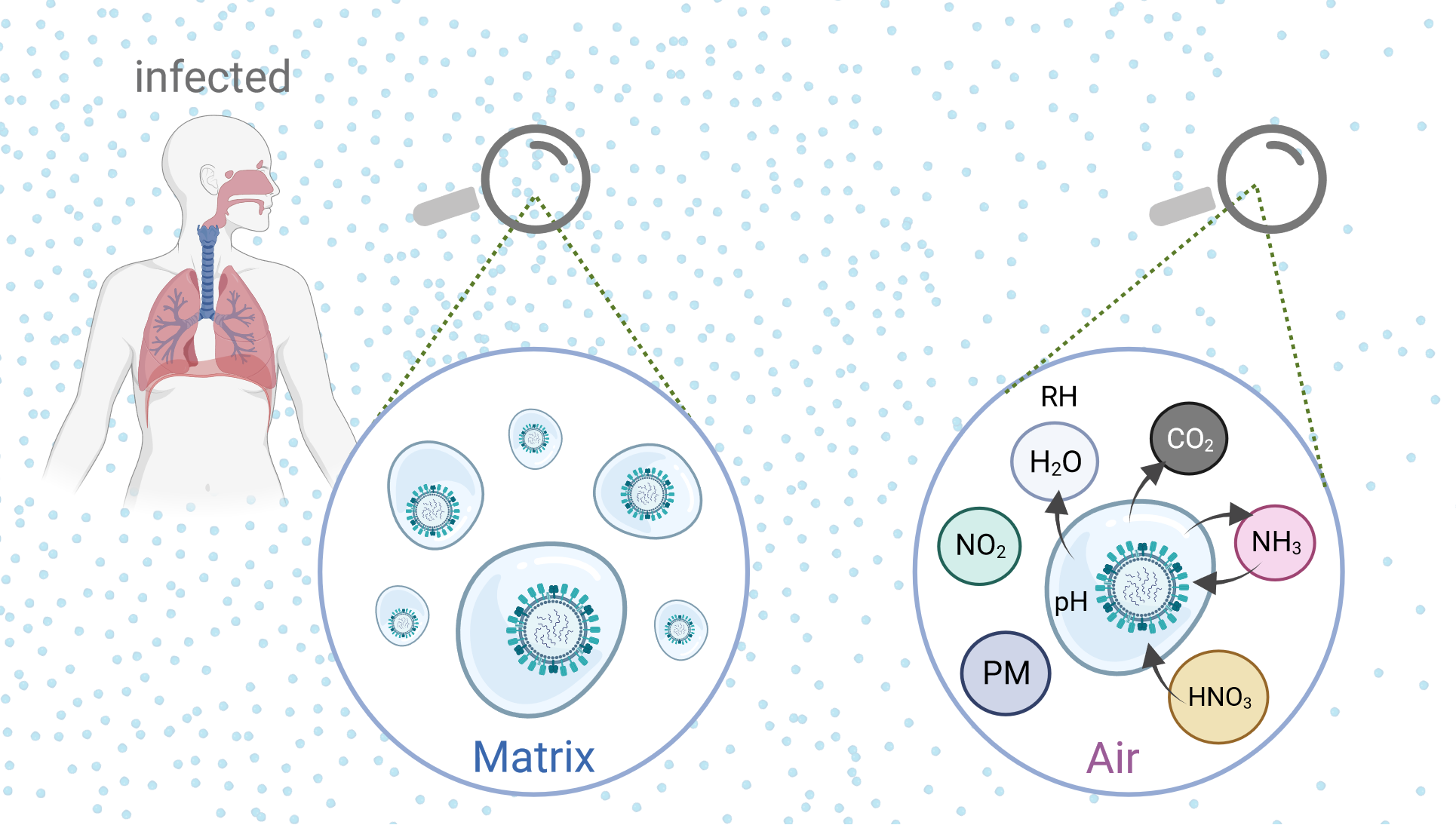
Despite the importance of airborne transmission for respiratory viruses our current understanding of the physicochemical processes that affect the infectivity of respiratory viruses in the aerosol and the susceptibility of the next host to airborne infection are limited. With this project, we aim to progress towards a better mechanistic understanding of the processes affecting virus stability in expiratory aerosols, for example, we study how relative humidity and gas phase composition control the physicochemical properties of expiratory aerosols, and how these in turn affect influenza virus infectivity.
With the work so far, we have developed a broad set of tools and assays to elucidate the role of air composition in the efficacy of airborne influenza virus transmission. These include an aerosol chamber compatible with biosafety level 2 work, a mathematical model for infectious aerosol particles, as well as primary human airway cultures as physiologically relevant system for aerosol production and susceptibility testing1, 2, 3. In ongoing work, we now apply and combine these tools to reveal mechanisms governing virus infectivity in aerosols. Our work can provide an intellectual framework for developing targeted strategies to curb disease transmission in indoor environments.
References:
- Luo B, et al. Expiratory Aerosol pH: The Overlooked Driver of Airborne Virus Inactivation. Environ Sci Technol 57, 486-497 (2023).
- Iseli AN, et al. The neuraminidase activity of influenza A virus determines the strain-specific sensitivity to neutralization by respiratory mucus. J Virol 97, e0127123 (2023).
- Glas I, et al. Inactivation of SARS-CoV-2 at acidic pH is driven by partial unfolding of spike. Commun Biol 8, 1082 (2025).